A WIBOR lawsuit is a case in which a borrower with a Polish zloty loan claims interest without WIBOR or asks the court to declare the agreement invalid. I handle these cases at my law firm in Gdynia, for clients from all over Poland. Before you sign anything, I read your agreement and tell you plainly whether a lawsuit makes sense.

A WIBOR lawsuit still makes sense in 2026, but after the CJEU ruling in case C-471/24 it is won with different arguments. The Court of Justice of the EU delivered this ruling on 12 February 2026. I tell clients this at the first meeting, because the whole strategy depends on it. The Court did not close the road to the courts. It moved the dispute to what the bank told you about the risk before you signed the agreement.
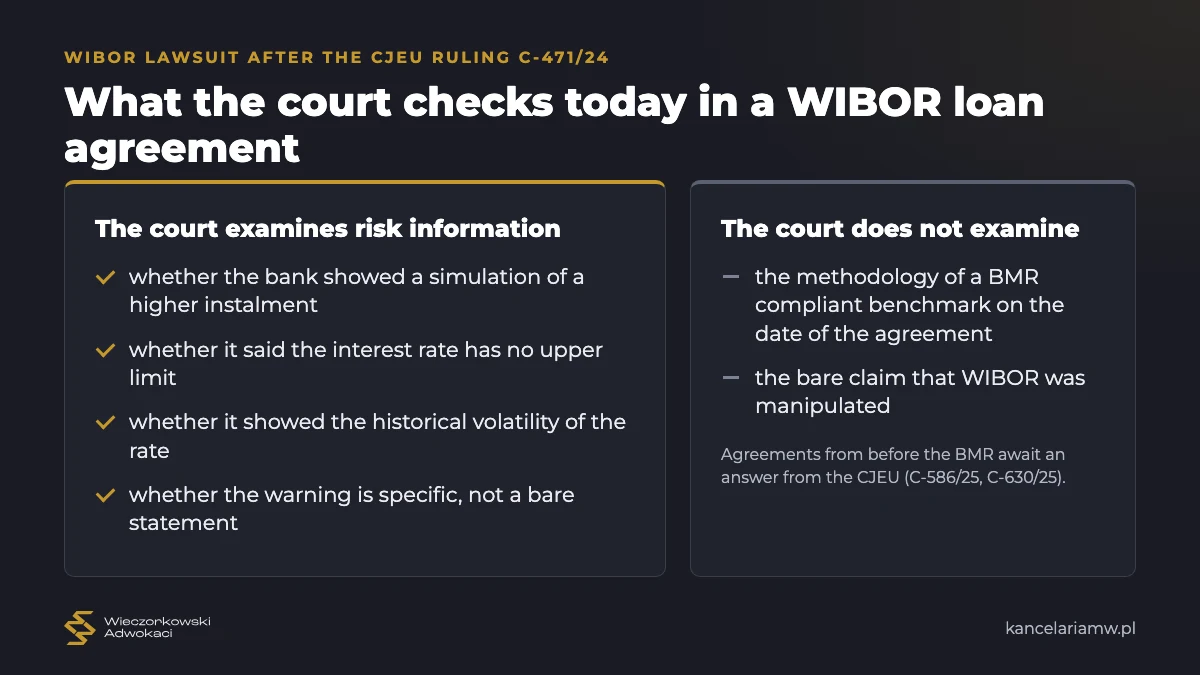
The CJEU ruled in case C-471/24 that a variable interest clause based on WIBOR is subject to review by the court from the point of view of consumer protection. That is good news. The second part of the ruling is harder for borrowers. The method of setting the benchmark, if it met the requirements of the EU Benchmarks Regulation (BMR) when the agreement was signed, cannot by itself decide that the clause is unfair.
In plain terms: the court will not examine whether WIBOR was "calculated correctly". It will examine whether the bank honestly showed you how a variable rate could hit your instalment. The Court also did not decide whether the agreement can continue on the margin alone once WIBOR is removed. National courts decide that issue. I discuss the ruling in detail on the blog, in the article on what the CJEU ruling C-471/24 means for borrowers (in Polish).
The WIBOR manipulation argument is no longer enough, because after the CJEU ruling the courts do not assess the methodology of a benchmark covered by the BMR regime. As recently as 2023, many lawsuits relied on a whistleblower's account and on the claim that WIBOR is manipulated. I wrote about it on this page. Today I say honestly: this route is closed for agreements signed after the BMR came into force and risky for the others.
This does not mean that the facts about the benchmark are irrelevant. I use them as a secondary thread. I put the weight of the case, however, on the bank's information duties, because that is where the courts still rule in favour of borrowers. A lawsuit built on the old argument is today a straight road to losing and to costs.
A strong WIBOR lawsuit today relies on what the bank did not tell you about the risk of a variable interest rate. In every agreement I check a few specific gaps:
The last point is often decisive. The sentence "I declare that I have been informed of the risk" without examples and figures is a good starting point for me. I assess an agreement differently if the bank attached written information with simulations. In that case I first obtain that document and read it, and only then assess the chances.
The date of the loan agreement matters a great deal after the CJEU ruling, because it determines which rules the bank had to meet. I assess an agreement from 2010 differently from one from 2015, and differently again from one from 2021. The BMR has applied since 1 January 2018. Ruling C-471/24 concerned an agreement from 2019, signed under that regime.
For agreements from before the BMR, the arguments are broader. Questions from Polish courts about exactly such agreements are pending before the CJEU (cases C-586/25 and C-630/25). Some courts even stay proceedings until the Court answers. That is why, for an agreement from 2009-2016, I do not transfer the conclusions of C-471/24 automatically.
| When you signed the agreement | Which rules protected you as a consumer | What I look at |
|---|---|---|
| until 17 December 2011 | Civil Code, Directive 93/13, Banking Law, Recommendation S of the Polish Financial Supervision Authority (KNF) | no simulation and no description of the risk, agreement from before the BMR |
| 18 December 2011 to 21 July 2017 | additionally the Consumer Credit Act of 2011 (information form) | content of the form, agreement from before the BMR |
| from 22 July 2017 | Mortgage Credit Act (ESIS form) | ESIS, information on interest rate risk, from 2018 also the BMR |
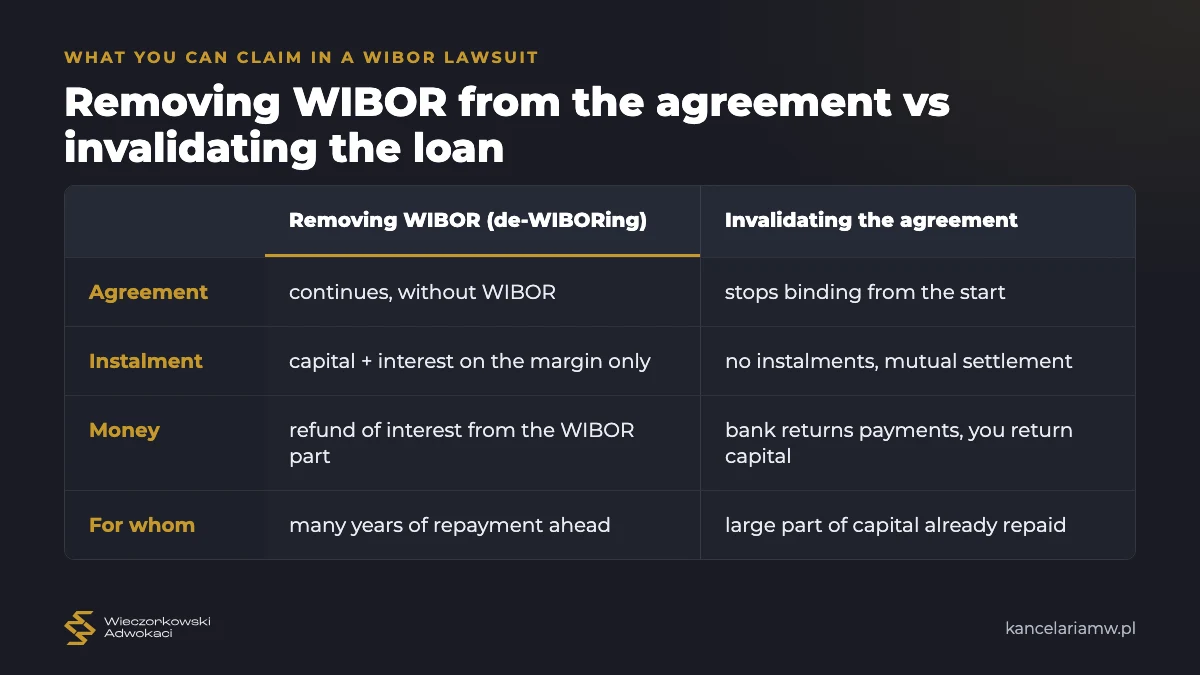
In a WIBOR lawsuit you can claim the removal of WIBOR from the agreement or a declaration that the whole loan agreement is invalid. I used to write here that the question should be put differently. That still holds: what counts is not what you can claim, but what is best in your situation. It decides whether winning actually gives you anything.
The choice of claim depends on the agreement, on how much you have already repaid, and on your plans. I usually set out a main claim and an alternative claim. The court examines the second one if it does not grant the first. On top of that comes an application for interim relief, which means a lower instalment for the duration of the case.
Removing WIBOR from a Polish zloty loan agreement means that from now on you repay the capital with interest calculated only on the bank's margin. On the market this is called "de-WIBORing" a loan. It is usually the most profitable option for someone who still has many years of repayment ahead.
On top of that comes a refund of the interest paid in the part based on WIBOR. The bank must return this money if the court finds the clause unfair. The agreement continues, with the same capital schedule and the same margin. One component of the instalment changes, but it is usually the largest one.
Example based on hypothetical assumptions. Your interest rate is 8.89%, of which 6.89% is WIBOR and 2% is the margin. After WIBOR is removed, the bank charges only those 2%. The result? An An instalment lower by as much as PLN 500, 1,000 or 2,000. The exact amount depends on how much of the loan you still have to repay.
Invalidating a Polish zloty loan agreement with WIBOR means that the agreement stops being binding from the start and the parties return everything they have paid each other. You return the capital paid out to you. The bank returns everything you paid it, meaning instalments, commissions and fees. You pay no interest on the capital.
This option can pay off when you have already repaid a large part of the capital. It is risky when the loan is recent. You may then face an obligation to return the capital quickly, which you simply do not have. That is why, before I propose a claim for invalidity, I calculate it on your figures. People also ask me about "cancelling WIBOR". It is the colloquial name for both routes, and the difference between them is fundamental for your wallet.
Do courts invalidate zloty agreements? Yes, although less often than in Swiss franc cases. One example is the judgment of the Regional Court in Suwałki of 30 March 2026 (I C 1046/25). The court found the WIBOR clause in an agreement from 2015 non-transparent and declared the whole agreement invalid. I compare both routes in the article on de-WIBORing or invalidating the loan (in Polish).
A claim for a fixed interest rate in a WIBOR lawsuit is possible, but only in an exceptional situation. It also relies on a different legal basis than unfair terms. The Civil Code allows the court to change an agreement when an extraordinary change of circumstances threatens a party with a grave loss or excessive difficulties. In short: you must have very serious problems repaying the instalment in its current form.
The court will then also consider the bank's interest. It is a narrow route and I assess it carefully. In most cases a better choice is a claim to remove WIBOR from the agreement, because it gives a similar effect, namely a fixed rate equal to the margin. It also does not require proof of a grave loss.
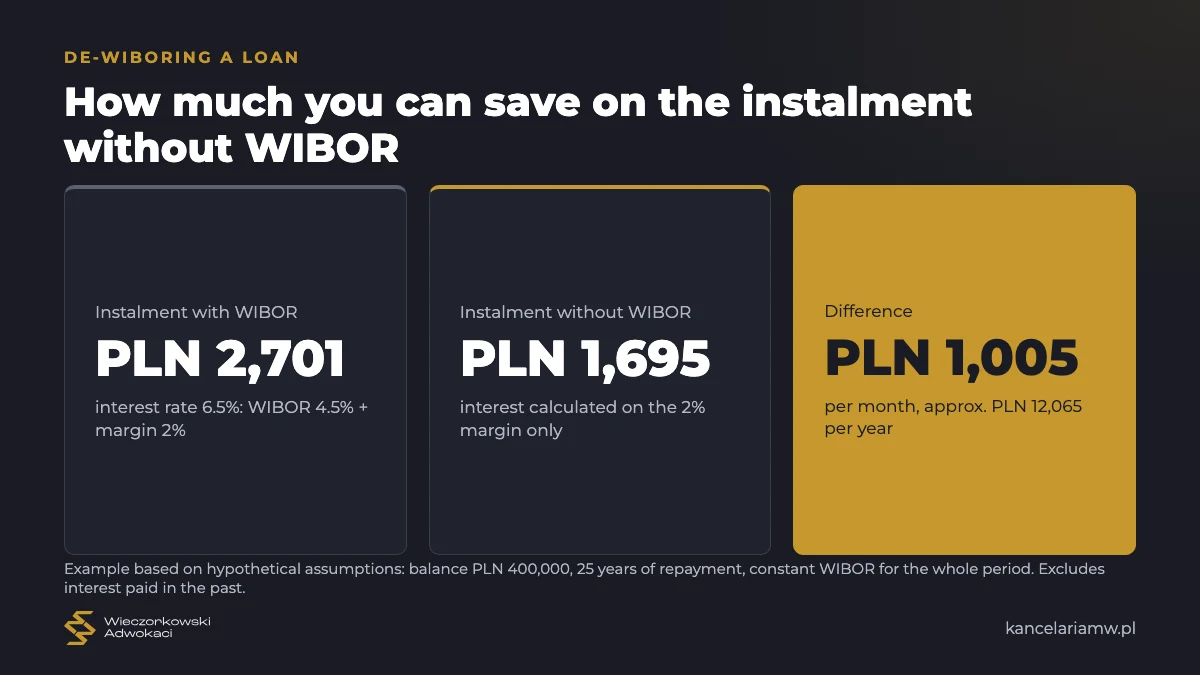
De-WIBORing a loan usually gives an instalment lower by several hundred to over a thousand zloty a month, plus a refund of overpaid interest. The exact amount depends on the balance, the repayment period, the margin and how high WIBOR stands. I do not give amounts blindly. I make every calculation on your repayment schedule.
You calculate the part of the instalment based on WIBOR by subtracting the instalment calculated on the margin alone from the full instalment. It sounds simple, but a loan has hundreds of instalments. That is why we prepared a WIBOR calculator (in Polish), which shows the difference in a few minutes. It is a good first step before you send us your agreement.
Example based on hypothetical assumptions:
| Assumption | Instalment with WIBOR | Instalment without WIBOR (margin only) |
|---|---|---|
| balance PLN 400,000, 25 years, WIBOR 4.5% + margin 2% | approx. PLN 2,701 | approx. PLN 1,695 |
| difference per month | approx. PLN 1,005 | |
| difference per year | approx. PLN 12,065 |
The calculation is simplified. It assumes a constant WIBOR for the whole period and does not include interest already paid. That interest is a separate amount, which you can claim from the bank.
After a win, the bank refunds the interest paid in the part based on WIBOR, provided the claim is not time-barred. For a loan repaid over a dozen or more years, this can be an amount of tens of thousands of zloty. I calculate it from the repayment history, which the bank issues on request. Limitation depends on the payment date of each instalment and on the moment you learned that the clause was unfair. That is why it is not worth waiting long.
A WIBOR lawsuit can also make sense after the loan is repaid, because repayment does not take away the right to a refund of interest. Only the aim of the case changes. You are not fighting for a lower instalment, but for a refund of money. For a loan repaid several years ago, the deadlines must be calculated carefully. I write more about this in the article on a repaid loan with WIBOR (in Polish).
A lower instalment during the case comes from interim relief, a court order that changes how the loan is repaid for the duration of the case. In WIBOR cases I most often ask for the interest part of the instalment to be calculated on the margin alone. You keep repaying the capital as usual. The bank receives regular instalments, and you save from the first months of the case.
After the CJEU ruling, courts are more willing to grant interim relief in the form of "instalment calculated on the margin alone" than a full suspension of payments. One example is the order of the District Court in Zawiercie of 24 September 2024 (I C 765/24). The court ordered the interest part of the instalment to be calculated only on the margin until the end of the case. It also prohibited the bank from terminating the agreement and from making entries in the BIK credit register in connection with this relief.
The court gave these reasons. This form of interim relief "on the one hand protects the claimants' interest, and on the other hand ensures that the bank receives regular repayments of capital and margin in monthly instalments". The Regional Court in Suwałki granted similar relief on 9 November 2026 (I Cz 314/26) for an agreement from 2016. Not every court rules this way. That is why I prepare the application in several variants. I describe this in more detail in the article on interim relief in a WIBOR case (in Polish).
The bank should not terminate the agreement when you pay a lower instalment in line with the interim relief. You then repay what the court ordered. One thing is key: you pay exactly according to the order, not according to your own calculations. Lowering the instalment on your own without interim relief is a mistake. It gives the bank an argument to terminate the agreement. On this website I also describe how suspending the repayment of a WIBOR loan instalment (in Polish) works.
The court should examine an application for interim relief without delay. In practice the time depends on the court and on any appeal. I file the application together with the lawsuit. You then pay no separate fee for it. If the court refuses, we consider an appeal. That is what happened in the Suwałki case, in which the second instance court reversed the refusal of the district court.
A WIBOR lawsuit at my law firm goes through five stages: analysis, decision, lawsuit, first instance and appeal. At every stage you know what is happening and what comes next. We work online, so you do not have to travel to Gdynia.
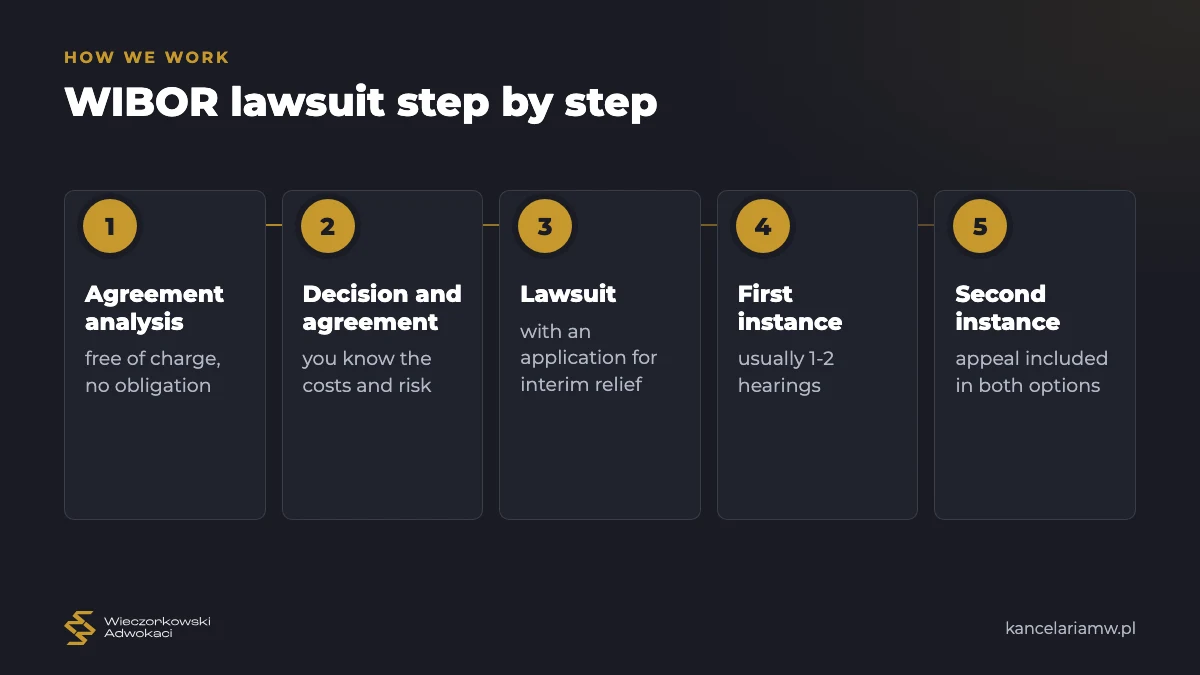
The analysis of the loan agreement is the first step, and you get it free of charge and without obligation. I read the agreement, the terms and conditions, the annexes and whatever the bank gave you at signing. I assess which legal regime covers your agreement, how the interest clause is built and what the bank wrote about the risk. Then I tell you plainly: worth it, not worth it, or worth it once the missing documents are obtained.
This answers the fear I hear most often: "I am afraid of going into a lawsuit blindly". You do not have to. You make the decision once you know the assessment, the costs and the risk. You can send the agreement through the agreement analysis form on adwokaciodwibor.pl or through the form on this page.
You sign the agreement with the law firm only after the analysis, when you know which fee option you choose and what it covers. Then we collect the documents. Most often these are the agreement with its annexes, the terms and conditions from the date of the agreement, the information form or ESIS and the repayment history. We request some of them from the bank on your behalf. You will find the full list in the article on documents for a WIBOR lawsuit (in Polish).
We prepare the lawsuit against the bank for your agreement, not from a template. I attach an application for interim relief to the lawsuit if it makes sense in your case. You pay the court fee. We take care of the rest: filing, contact with the court, replies to the bank's pleadings.
You are informed of every important pleading and deadline. In WIBOR cases there are usually one or two hearings. At the hearing, the borrower is most often heard. I prepare you for this in advance, so that you know what the court and the bank's lawyer will ask.
How long does it take? According to data from the Ministry of Justice, an average civil case before a regional court took approx. 14.8 months at first instance in 2025. This is the average for all cases of this type, not only banking cases. The time for the appeal comes on top. I describe the details and the differences between courts in the article how long a WIBOR case takes (in Polish).
A WIBOR lawsuit at my law firm costs PLN 12,300 gross, or PLN 4,500 gross plus 10% of the result. In both options there is an additional PLN 700 gross for each hearing. I prefer to state these amounts openly. A client who knows the price before the meeting makes better decisions. Both amounts cover proceedings at first and second instance.
Gross amounts, including VAT. The fee is payable within 7 days of signing the agreement. Costs of legal representation awarded against the bank after a win go to the law firm, in both options. Court fee on the lawsuit: PLN 1,000.
Option 1 is PLN 12,300 gross (PLN 10,000 net) for handling the case. On top of that comes PLN 700 gross for each hearing. There are usually one or two hearings. You give the law firm no part of what you obtain from the bank. This option is usually chosen by people with a large balance and a strong case, because it leaves them more after a win.
Option 2 is PLN 4,500 gross for handling the case and PLN 700 gross for each hearing. On top of that comes 10% gross of everything you obtain from the bank. The result includes the principal amount, interest and the cancelled loan balance. Example based on hypothetical assumptions: if the bank refunds PLN 60,000 to you, the law firm's share is PLN 6,000 gross.
Note the cancelled balance. If the agreement is invalid, the balance disappears only on paper, and 10% of it is a real amount to pay. That is why, for this option, I always set out the result on your figures. You pay the flat fee in option 1 or the starting fee in option 2 within 7 days of signing the agreement.
Court costs in a WIBOR case are mainly a PLN 1,000 fee on the lawsuit and PLN 17 stamp duty. A consumer suing a bank pays a fixed fee when the value of the dispute exceeds PLN 20,000. For a lower value, the fee is smaller. An application for interim relief included in the lawsuit is free of charge.
Our agreement also contains one condition that you must know before signing. Costs of legal representation awarded against the bank after a win go to the law firm, in both options. I set out the full cost breakdown, including appeal fees, in the article how much a WIBOR lawsuit costs (in Polish).
As a rule, a lost case against the bank costs a refund of the bank's costs of legal representation, calculated according to the rates in the regulation. I do not hide this information, because it is the most common question after the question about the chances. Example based on hypothetical assumptions, at the minimum rates:
| Value of the dispute | Lost at first instance without appeal | Lost at both instances |
|---|---|---|
| PLN 150,000 | PLN 5,400 | PLN 9,450 |
| PLN 250,000 | PLN 10,800 | PLN 18,900 |
On top of these amounts come your own fees and the law firm's fee. In particularly justified cases the court may also reduce the costs or not award them. I do not build a plan on that, however. I discuss the cost risk with you before we file the lawsuit.
Analysis of your loan agreement free of charge and without obligation. You will learn whether it is worth acting, which route to take and what it costs.
A WIBOR dispute with the bank has the best chances when the bank did not show you the real risk of a variable rate. It helps when the agreement contains only a general statement about the risk. Case law is not uniform. There are judgments favourable to borrowers and there are judgments dismissing the claims. I say this openly, because an honest assessment protects your money.
After the CJEU ruling, both favourable and unfavourable judgments are issued in WIBOR cases. The Regional Court in Kalisz issued a preliminary judgment on 13 August 2026 (I C 1669/23). It found the WIBOR provision in two agreements from 2018 ineffective, with the margin kept. The reason? The bank did not prove that it had given reliable information about the risk of a variable interest rate.
The Regional Court in Suwałki (I C 1046/25) stated that the BMR does not apply to an agreement from before it came into force. On the other hand, on 25 February 2026 the Supreme Court (II CSKP 556/24) dismissed the borrowers' cassation appeal. It concerned an agreement from 2010. Judgments dismissing borrowers' claims are also issued by the courts of appeal. I keep an up-to-date overview in the article on WIBOR case law (in Polish).
I assess more cautiously the agreements to which the bank attached written information about the risk with numerical examples of instalment increases. I am also careful with loans that mostly served a business activity. You may then not have consumer status, and that changes the whole case. I write about this in the article on a WIBOR loan and business activity (in Polish).
I am also cautious about an interest rate change clause that works automatically and unambiguously. An attack on the "bank's discretion" under such a clause loses. It is better then to base the case on the lack of information about the risk.
Questions about agreements from before the BMR are waiting for an answer from the CJEU. Courts also ask whether, without WIBOR, the agreement continues on the margin alone or falls. These are cases C-586/25 and C-630/25. A third case, C-607/25, concerns the lack of an upper limit on the interest rate in a mortgage loan. The Court has announced its judgment in that case for 26 November 2026. I follow these cases closely and describe them on the WIBOR blog (in Polish).

A short PDF guide (in Polish): how WIBOR works, what your instalment consists of and what you can claim from the bank. No registration, you download it straight away.
Download the free e-bookA Polish zloty loan with WIBOR is most often a mortgage for a flat or a house, but clients' situations differ a lot. Below I describe the ones I see most often. Each needs a slightly different approach to the lawsuit.
It is better to read an annex changing WIBOR with a lawyer before signing, because it may affect your claims against the bank. Banks send annexes related to the reform of benchmarks. Some of them contain statements that the bank will later use in court. I describe this in the article WIBOR annex: should you sign it (in Polish).
A loan with a former spouse or another co-borrower does not rule out a WIBOR lawsuit. You do, however, need to establish who will act against the bank. It is simplest when you sue together. When contact is difficult, we look for a solution before we file the lawsuit. It is one of the first things I ask about during the analysis.
Selling your flat or overpaying the loan does not take away your right to a WIBOR lawsuit, but it is worth planning with a lawyer. After early repayment, the aim of the case changes to a refund of money. Collect the documents from the bank before the loan is closed. Afterwards it can be harder.
A loan inherited from a close relative can also be the basis for a WIBOR lawsuit. The heir takes over the rights and obligations of the borrower. First we establish who inherits and in what shares. Then we assess the agreement in the same way as for any other loan.
You choose help with removing WIBOR from your loan agreement for several years. What matters most is who handles your case and how you contact them. I have run my law firm since 2017. For years I have handled disputes with banks: Swiss franc cases, free credit sanction cases and WIBOR cases. Your case is handled by an attorney, not a call centre.
Your WIBOR case is handled by me, attorney Maciej Wieczorkowski (adwokat), together with the law firm's team of attorneys and legal advisers. I am entered on the list of attorneys of the Płock Bar Association. The law firm has its office in Gdynia at ul. Śląska 53/C401. You have one contact person who knows your agreement and answers your questions.
Contact with the law firm during the case is simple: we inform you of every important pleading, deadline and court order. You write by email or call during the law firm's working hours, Monday to Friday. We hold meetings online or in Gdynia. Clients tell me that at other law firms "contact stopped after the agreement was signed". That is not the case here, because every case has its own attorney.
Our work in disputes with banks stands out for being specific, fast and honest about the chances before you sign an agreement. In practice this means a few things:
We do not bring group lawsuits. We assess and handle every agreement individually, because in WIBOR cases the result depends on the details of the specific agreement.
I handle WIBOR lawsuits from my law firm in Gdynia for clients from Gdańsk, Sopot, the whole Tricity and all over Poland. The office is at ul. Śląska 53/C401 in Gdynia. We handle most WIBOR cases remotely, however: you send the documents online, and we talk by phone or video.
You do not have to live in the Tricity to use the services of our WIBOR law firm, because we handle cases before courts all over Poland. Clients write to us from Wrocław, Opole, Łódź, Olsztyn and many smaller towns. The lawsuit is filed with the court competent for your case, not for the law firm. We or the law firm's team travel to the hearings.
We handle a WIBOR lawsuit in Gdańsk and Gdynia in the same way as in other cities. The difference is mainly the convenience of contact. Clients from the Tricity can meet me in person at the office in Gdynia. They can also bring the documents instead of scanning them. The lawsuit itself, the analysis of the agreement and the application for interim relief are identical.
In a WIBOR matter it is best to start with an analysis of the agreement, because it gives you a specific answer for your agreement, not general advice. You send the agreement, and we tell you whether it is worth acting and which route to take. If you prefer to talk first, choose a date in the calendar below or call: +48 605 622 598.

